19 Feb 26
From clarity to narrative: what story are you living?

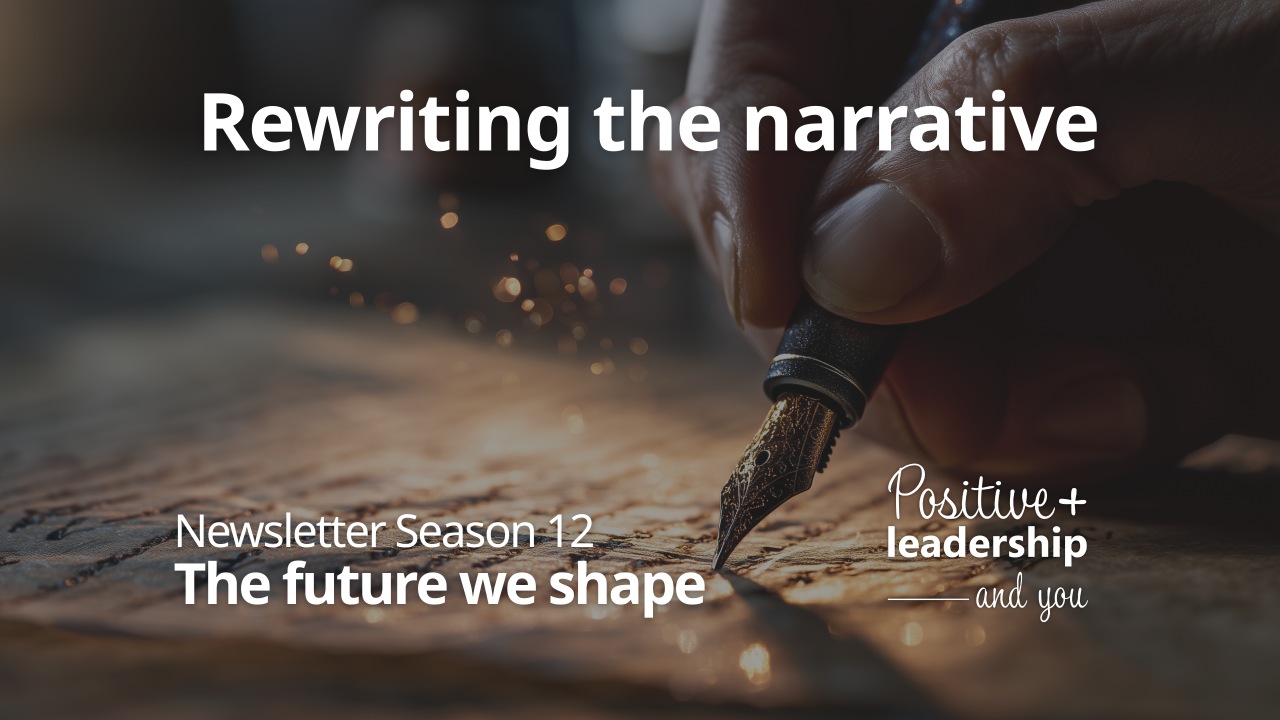
Last month, we focused on preparing your mind – creating the inner clarity that allows you to shape the future rather than drift into it. But once your mind is clear, a new question emerges:
If you look at the headlines in early 2026, the dominant narrative is one of borrowed pessimism. Algorithms feed us stories of fragmentation, climate doom, and distrust. The 2025 Edelman Trust Barometer confirmed what we all feel: we’ve entered an era of “Insularity,” where trust in traditional media and government has collapsed, leaving a vacuum of meaning.
Over forty years of leadership – at Microsoft oft, in philanthropy, in education – I’ve learned a hard truth:
If you tell your team the future is bleak, scarcity will drive their decisions. If you tell yourself you’re a victim of circumstance, you will miss the agency you actually hold.
This month, I’m asking you to stop outsourcing your worldview.
We’re going to explore the neuroscience of narrative, reflect on Microsoft’s cultural transformation, and identify three specific narrative traps you must reject today to shape a better tomorrow.
This isn’t just philosophy – it’s biology.
Neuroscience has shown us that when we hear a list of facts, only the language-processing parts of our brain light up. But when we hear a story, something remarkable happens: neural coupling. The listener’s brain activity literally synchronizes with the storyteller’s. We don’t just “hear” the future you describe – we experience it emotionally.
This is why positive leadership is not about “spinning” the truth. It’s about choosing which truth to amplify.
At Microsoft, I lived through a massive narrative shift. We transitioned from a culture of “know-it-alls” (a narrative of intellectual dominance and perfection) to “learn-it-alls” (a narrative of curiosity and growth).
It gave employees permission to be wrong, which gave them permission to innovate. The story we told ourselves changed the company we became.
Three positive leaders who taught us how to rewrite the script
Here are three conversations from the Positive Leadership Podcast that fundamentally changed how I think about the narratives we inherit – and how we can consciously rewrite them.
The Guest: Bozoma Saint John (Former CMO of Netflix , Apple music )
We often accept the roles society writes for us. We wait to be invited to the table. We wait for the “right time.”
Bozoma completely dismantles this narrative of patience.
In our conversation, she introduced me to the concept of the “urgent life.” After suffering profound personal loss, she realized that waiting is a luxury we don’t have. Representation isn’t just about being seen – it’s about ensuring your voice shapes the plot of the room you’re in.
🚫 The Narrative Trap to Reject: “I have to wait for permission or the perfect moment to speak.”
✅ The Story to Tell: “My voice is necessary now for the future we’re building.”
🎧 Deep Dive: Living with Urgency with Bozoma Saint John :
Living with urgency (with Bozoma Saint John)The Guest: Jacqueline Novogratz (Founder of Acumen )
How we talk about challenges shapes how we solve them.
Do we see “problems to fix” or “people to empower”?
Jacqueline changed my worldview on social impact. For decades, the narrative of aid was based on pity and transaction. Jacqueline rewrote this into a narrative of “moral imagination” and dignity.
She argues that if we want to build a better world, we must move from a story of “saving the poor” to “standing with the poor.” It’s a shift from seeing people as beneficiaries to seeing them as customers and partners.
🚫 The Narrative Trap to Reject: “They need our help.” (The Savior Complex)
✅ The Story to Tell: “We need each other to solve this.” (The Partnership Model)
🎧 Deep Dive: Building a Better World Together with Jacqueline Novogratz
Building a better world together (with Jacqueline Novogratz)The Guest: Nicholas Thompson (CEO of The Atlantic )
Finally, there’s a narrative we rarely examine: the story we inherit about ourselves.
Nick Thompson is a brilliant journalist and media executive – but he’s also an extraordinary storyteller about life itself. His recent book, @TheRThe Running Ground, isn’t just about running. It’s about how we consciously choose which family narratives to carry forward and which to let go.
Nick grew up watching his brilliant, complicated father – a Rhodes Scholar who became an academic star – whose life eventually “cracked up” due to alcoholism and personal struggles. Around Nick’s 40th birthday, his father publicly warned him: “All men’s lives fall apart at this age.”
That was the narrative Nick had inherited. A script of inevitable decline. A story that said: success is fragile, and you will fail.
But Nick refused to live that script.
Instead, he took up running – not to escape his father’s shadow, but to honor what they shared while writing a different ending. Running became his therapy, his discipline, his way of processing inherited pain while reclaiming his own identity.
At age 44, after his father’s death, Nick ran a 2:29 marathon – one of the fastest times in his age group in the world. At 45, he set an American record in the 50K. He didn’t just defy expectations about aging. He defied the narrative that his father’s fate was his destiny.
In our podcast conversation, Nick told me: “I run because of my father. Running connects me to my father; it reminds me of my father; and it gives me a way to avoid becoming my father.”
That sentence stopped me. Because it’s not just about running.
It’s about the stories we inherit from our families, our companies, our cultures – and our responsibility to examine them.
Which narratives serve us? Which hold us back? And which ones do we need the courage to rewrite?
🚫 The Narrative Trap to Reject: “I am destined to repeat the patterns of those who came before me.”
✅ The Story to Tell: “I honor where I come from while consciously choosing who I become.”
🎧 Deep Dive: Leading with Integrity and Purpose with Nicholas Thompson
Running From and Running Toward: Rewriting the Stories We Inherit with Nicholas ThompsonIn a world where trust has collapsed, people are no longer looking to institutions for the story of the future.
They’re looking to individuals. They’re looking to you.
As leaders, we have a profound responsibility: to tell stories that expand possibility rather than limit it.
Hope is not naivety. It’s a strategic choice. It’s the refusal to let fear write the ending.
Next time you’re in a meeting and you hear a limiting belief – “We can’t do that,” “It’s too late,” “That’s just how the industry is” – I want you to pause.
Ask yourself: Who wrote that story? And do I have the courage to edit it?
The narratives you choose to believe will shape the future you create.
Be the narrator of possibility.
Next month, we’ll explore how communities become the soil where new narratives take root – and how positive leadership creates the conditions for collective transformation.
But none of that works if we skip this step: examining the stories we’re living and choosing to rewrite the ones that no longer serve us.
- Subscribe to the Positive Leadership Newsletter to follow this full season
- Revisit the podcast episodes with Bozoma Saint John, Jacqueline Novogratz, and Nicholas Thompson for deeper insights
- Share in the comments: What narrative are you ready to rewrite in your own life or organization?
The future is not waiting for us. It is responding to the stories we’re brave enough to tell.
Warmly, Jean-Philippe Courtois
👉 Discover more episodes and resources at www.jpcourtois.com