30 Jul 26
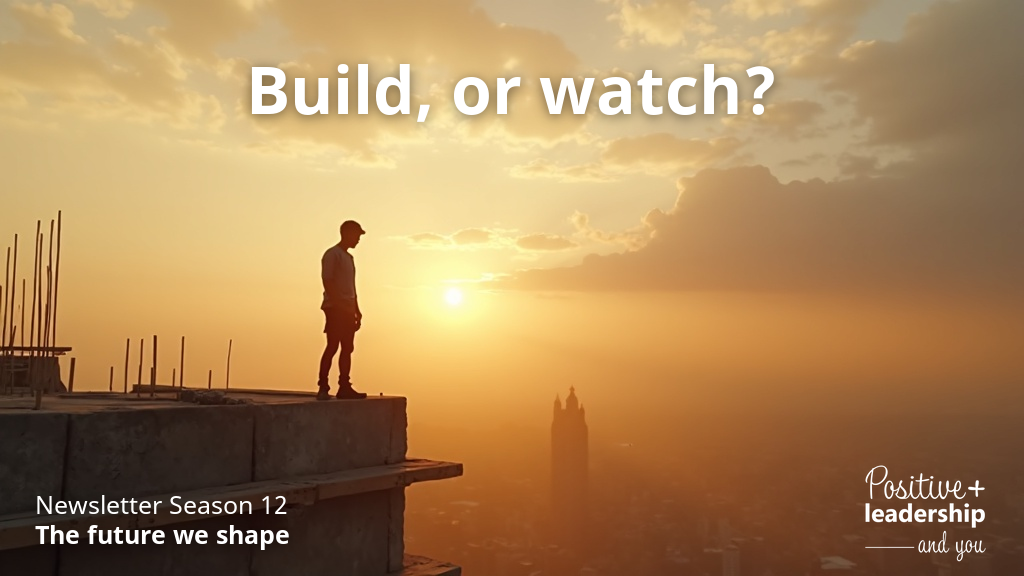
Are you building the future, or just watching it happen?
There is an old story I keep coming back to.
A traveler passes three workers cutting stone. He asks each one what they are doing. The first says he is cutting a block of stone. The second says he is earning a living. The third one looks up and says, "I am building a cathedral." Three people, the same task, three completely different relationships to the future.
Last month, I promised we would turn inward this July, to the question underneath all the others: where does the energy to keep growing other people actually come from, and how do you protect it before it runs out?
Here is the honest answer I have found, in my own life. That energy does not come from inside you alone. It comes from working on something bigger than yourself. It comes from a second mountain. For the first half of a career, most of us climb the first mountain: title, scope, results, recognition. The second mountain is different. You climb it for other people, and for a future you may never fully see. That is where the deepest energy lives. And it leads straight to this month's question:
Are you building the future, or just watching it happen?
Where we have been
Since January, this season has been building toward something. We started with preparing your mind, then rewriting your narrative, then the power of communities, then reimagining education for an AI-first world, then investing in the next generation, and last month, leadership itself: do people grow around you, or just survive you?
This month we reach the point of it all. Not just how we lead, but what we choose to build, and who we choose to build it with.
The future needs builders, not commentators
We live in the golden age of commentary. Every problem has ten thousand takes. Every crisis has a thread. It has never been easier to have an opinion about the future and never harder to actually build it.
The people I most admire are the ones on the third worker's side of that old story. They are not describing the cathedral. They are laying the stone. And the uncomfortable truth is that our organizations, our schools, and our institutions are far better at producing commentators than builders. We reward the sharp analysis, the confident critique, the well-argued why-it-will-fail. We rarely reward the person quietly attempting the thing everyone else called impossible.
That is the gap this edition is about. Because the future will not be shaped by the loudest analysis. It will be shaped by the people willing to be wrong in public, over and over, until they are right.
The numbers worth sitting with
The appetite is there, especially among the young. In Deloitte 's 2025 Global Gen Z and Millennial Survey of more than 23,000 people across 44 countries, roughly nine in ten said a sense of purpose matters to their job satisfaction and wellbeing: 89% of Gen Z and 92% of millennials. Young people do not want to sit out the future. They want to build it.
The problem is not desire. It is backing. Look at what happens when someone chooses to back builders instead of just applauding them. Through Ashoka , Bill Drayton has supported more than 4,000 changemakers across 95 countries. At Live for Good , the organization I co-founded, we have walked alongside hundreds of young social entrepreneurs, not with a cheque and a photo, but with mentoring, network, and years of patient belief.
Those numbers are not large because the talent is rare. They are large because someone decided to recruit, train, and empower the talent that was already there, waiting for a door to open.
The ten years that changed how I see my own role
For a long stretch of my career, I measured myself by scale. Bigger markets, bigger teams, bigger targets. That is the first mountain, and I climbed it hard.
What changed me was the last ten years alongside young social entrepreneurs at Live for Good. I went in thinking I would teach them what I had learned running large organizations. I came out having learned more than I taught. These are people in their twenties taking on problems that would intimidate a seasoned executive, with a fraction of the resources and none of the safety net, and doing it anyway. Watching them did something to me. It moved my sense of purpose from what I could achieve to what I could enable.
That is the shift I want to offer you this month. There is a version of leadership that is about being the most capable person in the room. And there is a version that is about being the reason other capable people get their shot. The second one is harder, slower, and far more lasting. It is the second mountain. And it is the only kind of leadership that compounds after you are gone.
Four voices that reframe what it means to build the future
These are four conversations from the Positive Leadership Podcast that go straight to the heart of this question.
1. Change the system, do not just serve it
The Guest: Bill Drayton , Founder and CEO of Ashoka, who coined the term "social entrepreneur" in 1972.
When I asked Bill to define what a social entrepreneur actually is, he did not start with charity. He started with ambition.
"Start with the word entrepreneur. That means changing the system. It's not direct service," he told me. A social entrepreneur, he added, is someone "from deep within driven to serve the good of all."
That distinction is everything. Direct service treats the symptom. A builder changes the system that produced it. The future needs both, but it is desperately short of the second.
🚫 The Trap to Reject: "Doing good means helping people one by one."
✅ The Story to Tell: "Doing good at scale means changing the system that keeps people stuck. I back the builders who redesign it."
🎧 Deep Dive: Being a changemaker, with Bill Drayton
Being a changemaker (with Bill Drayton, Ashoka Founder and CEO)2. Solve the problem, do not just admire it
The Guest: Boyan Slat , Founder of The Ocean Cleanup , who dropped out of university at 18 to start it.
Boyan told me the story of scuba diving as a teenager and seeing more plastic bags than fish. Most of us would have felt sad and moved on. He did something else.
"Rather than sitting around and feeling sad about it, my engineering mind just quickly went to, okay, so how do we solve this?" And when I asked why he keeps going through failure after public failure, his answer was pure builder: "We're not in the business to clean up a bit of plastic. We're here to solve the problem."
That is the difference between caring about the future and committing to it. Caring stops at the feeling. Building starts at the question, "so how do we solve this?"
🚫 The Trap to Reject: "The big problems are too complex for one person to take on."
✅ The Story to Tell: "Every problem starts with someone refusing to just feel bad about it. My job is to find that person and give them the means to try."
🎧 Deep Dive: Leading an ocean clean-up, with Boyan Slat
Leading an ocean clean-up (with Boyan Slat)3. Fund them, and do it without playing the saviour
The Guest: Durreen Shahnaz , founder and CEO of Impact Investment Exchange (IIX) , who built the world's first social stock exchange and created the Women's Livelihood Bond.
Durreen grew up in Bangladesh and went into finance for one reason: that is where the power sits. When she started IIX, she told me, it "really was to make the financial markets inclusive." Nobody wanted it. "When we first went out in the market, everyone thought it was crazy. They wouldn't invest because they're like, what? Women? Like, what?"
So she used the machinery of high finance against its own habits, taking the same structures that caused the 2008 crisis and pointing them somewhere else. Her phrase for it has stayed with me: "high finance, as I like to say, for low markets." And she is very clear that this is not charity dressed up. It is a better trade: "the deeper the impact you have, the financial risk goes down."
Above all, she refuses the posture that ruins most well-meaning capital. She does not arrive to rescue anyone. She arrives to open a market that should have been open already.
🚫 The Trap to Reject: "Backing builders in hard places means accepting a worse return."
✅ The Story to Tell: "I fund builders because the impact makes the risk smaller, not bigger. And I back them as equals, not as people who need saving."
🎧 Deep Dive: A Defiant Optimist Transforming Global Finance, with Durreen Shahnaz
A Defiant Optimist Transforming Global Finance (with Durreen Shahnaz)4. Back them, then make them part of something bigger
The Guest: Jeff Raikes , co-founder of the Raikes Foundation , former President of the Microsoft Business Division, and former CEO of the Gates Foundation . He was also one of my own managers and mentors.
Jeff learned generosity young. He still remembers his father pulling a stranded couple out of a snowdrift in a Nebraska blizzard and refusing their money: "I don't want to take any of your money. I just want you to pay it back to somebody else in the future."
And when I asked him what has driven him across business and philanthropy, he named the thing that outlasts any title: "The greatest thing in humanity is when you can feel like you're part of something bigger than yourself."
That is what the best leaders give the builders around them. Not just funding. A place in a story larger than their own ambition.
🚫 The Trap to Reject: "Once I have succeeded, I will give back."
✅ The Story to Tell: "Backing the next builder is not what I do after the work. It is the work. And it is how I stay part of something bigger than myself."
🎧 Deep Dive: A Journey of Leadership and Giving Back, with Jeff Raikes
Special 100th episode! A Journey of Leadership and Giving Back (with Jeff Raikes)What the future is really asking of us
Here is the provocation I want to leave with you.
We keep waiting for the future to be delivered to us, by technology, by governments, by someone with more power than us. It will not be. The future is not a forecast. It is a construction site. And every construction site needs three kinds of people: those who become builders, those who support builders, and those who fund them.
Bill Drayton became one. Boyan Slat is one. Durreen Shahnaz built the market that funds them. Jeff Raikes spent a career learning to back them. The question this edition puts to you is simply which of those three roles you are going to play this year, because sitting in the stands and grading the effort is not one of the options that shapes anything.
Positive Leadership, in this light, is not soft. It is the most practical thing in the world. It is the deliberate act of finding the people who will build what comes next, and making sure they are not doing it alone.
Three questions worth holding this month
Think of the most promising young builder you know. Have you actually done anything to open a door for them, or have you only admired them from a distance? Admiration costs nothing. A door costs something, and that is the point.
When you last saw a hard problem, was your first instinct to explain why it is hard, or to ask, "so how do we solve this?" One instinct makes you a commentator. The other makes you a builder. You can change which one fires first.
And the honest one. If you disappeared from your field for a year, would the future you claim to care about still get built, because you invested in people who could carry it, or would it stall because you were the only one holding it?
A challenge for the summer
Before the next edition, do one concrete thing for one builder. Not a like. Not a comment. A door.
Introduce them to someone who can change their trajectory. Fund a piece of their work. Give them a stage. Or simply spend an hour helping them think through the wall they are stuck against. Pick a real person, take a real action, and watch what it does, not just for them, but for your own sense of why you lead at all.
Over the summer I will be sharing a compilation of the conversations that shaped this season, so you can go back to the builders and thinkers whose ideas are worth a second listen.
The future is not something that happens to you
For years I watched the future from a position of scale and influence, and I thought that was the same as building it. It was not. Influence lets you comment on the future with a bigger microphone. Building it means putting your belief, your network, and sometimes your money behind a specific person who is trying to make it real.
The cathedral builders never saw their cathedrals finished. They laid stone for a future they trusted would arrive long after them. That is the quiet greatness this season keeps pointing to. Not the leader who is the most impressive person in the room, but the one whose belief becomes the reason a future gets built at all.
So this summer, become a builder, support one, or fund one. Just do not only watch.
Make the next one count.
Warmly,
Jean-Philippe Courtois