16 Jul 26
The Invisible Weight of AI: Who Is Really Carrying Your Transformation?
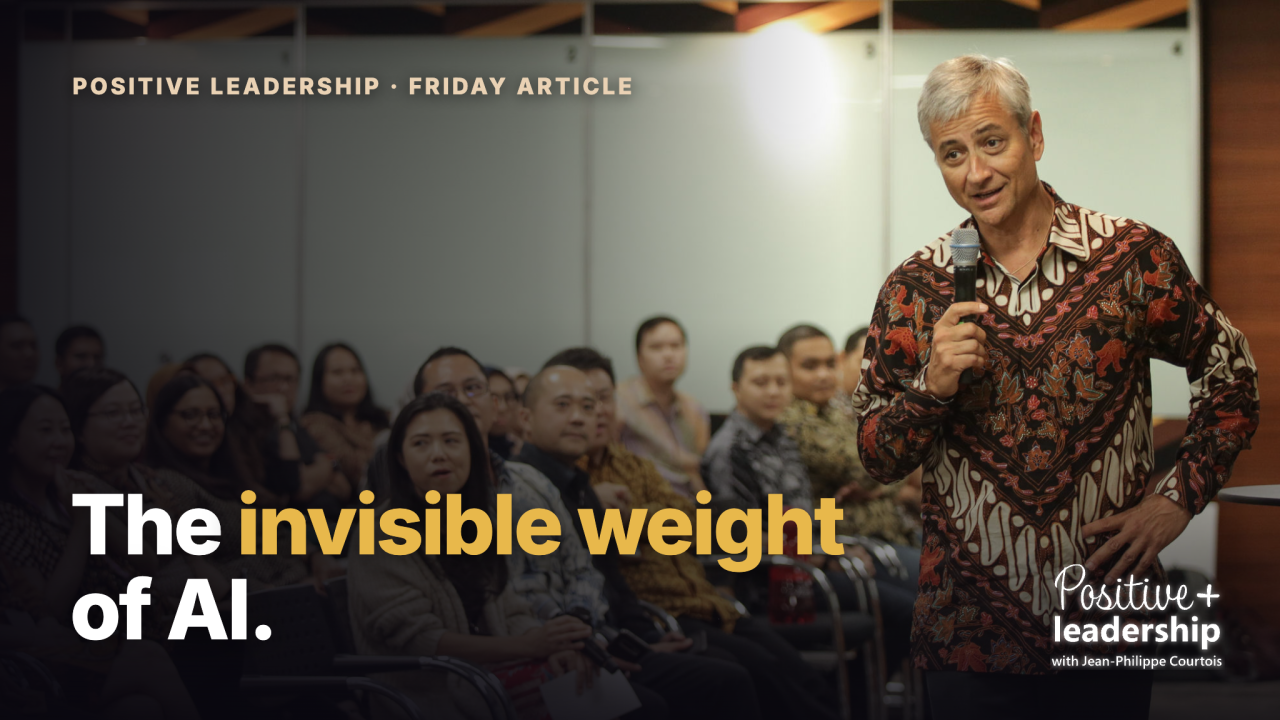
Every AI rollout gives middle managers a second job. Whether we help them carry it is a leadership choice, not a technology decision.
When we began transforming Microsoft 's global sales organisation for the cloud, we did not start with technology. We started with 3,500 middle managers across more than 120 subsidiaries. They were the critical link between our global strategy and thousands of frontline employees serving customers every day.
And we were asking them to do something extraordinarily difficult: Perform and transform.
Deliver today's results while helping their teams learn new technologies, adopt new business models and reinvent how they created value for customers.
We knew another tool, target or presentation would not be enough. So we invested in their human capital.
We trained our managers to become coaches. We encouraged them to move from a know it all mindset to a learn it all mindset. From providing every answer to asking better questions. From directing change to modelling it.
We also created more opportunities for collective learning. Managers shared successes, failures and emerging best practices across countries and markets.
That investment became one of the decisive factors in our transformation.
Because people rarely experience transformation through a strategy document. They experience it through the behaviour of their manager.
I returned to that lesson after reading a powerful Harvard Business Review article by Julia Shin and Sandra Sucher : "AI Adoption Is Overloading Your Middle Managers." It identifies a challenge many organisations still underestimate.
Most organisations approach AI adoption as a technology rollout. But technology does not adopt itself.
Someone must translate its promise into a new workflow. Someone must decide when its output can be trusted and when human judgement must prevail. Someone must manage its mistakes, coach the team and answer the question employees are quietly asking:
What does this mean for me?
That person is usually a middle manager.
Yet much of this work remains invisible. It appears in no adoption dashboard. It is rarely included in objectives. It is simply added to an already full agenda.
We celebrate the tool. We rarely measure the weight we have handed to the person expected to make it work.
Our managers at Microsoft had to deliver quarterly performance while building the capabilities required for the future. They had to help successful professionals question expertise that had served them well for years. They had to learn unfamiliar technologies while creating confidence for others. They had to embody a new culture before they had fully mastered the new world themselves.
This is why coaching mattered.
The traditional manager is often rewarded for knowing, directing and controlling. The transformational manager must also listen, question, learn, experiment and help others grow.
A learn it all manager can say:
"I do not yet have the answer, but we are going to learn our way forward together."
That is not weakness. In a period of disruption, it is leadership.
But mindset change does not happen through a single training session. It requires practice, feedback, role models and protected time. It requires communities where managers can speak honestly about what is failing, learn from what is working and adapt those lessons to their own teams.
Transformation is not a memo you send. It is a capability you build across the organisation.
The part of a manager's role that AI cannot easily replicate is precisely the part people need most during change.
The reassurance in a voice. The ability to read a room that has gone quiet. The judgement to recognise that resistance may actually be fear. The moment a manager notices someone is overwhelmed and creates space for an honest conversation.
If we overload managers with the mechanics of AI adoption, we deprive them of the time and attention required for this human work. We may automate more tasks while weakening the relationships that make transformation possible.
I am profoundly optimistic about AI. I use it every day and believe it is one of the greatest enablers of progress of our time. That is exactly why I care about the people carrying its adoption.
When a new technology arrives, the natural instinct is to purchase licences and provide technical training. Both are necessary. Neither is sufficient.
Managers do not need to possess every answer about a technology that changes every few months. They need to build teams that learn faster than the technology changes. That requires curiosity, humility and the ability to lead through questions, not only instructions.
It also requires deliberate choices from senior leaders. If AI adoption creates additional work through coaching, checking outputs, redesigning processes and managing uncertainty, that work must be recognised and resourced.
Perform and transform cannot mean perform more and transform in your spare time.
Leaders must remove low value work. Protect time for learning. Invest in coaching. Create communities where frontline experience and best practices can circulate quickly.
And recognise that middle managers are not simply implementing the transformation. They are leading it.
Every AI transformation creates a decision that no technology provider can make for you.
You can treat adoption as a software rollout and allow middle managers to absorb the shock. Or you can treat it as a leadership transformation and invest in the people responsible for making it real.
At Microsoft, investing in 3,500 managers as coaches helped turn a global ambition into thousands of local acts of transformation. It helped our managers become visible examples of the culture we wanted to build. It helped frontline teams learn from one another. And it helped us perform and transform at the same time.
The same principle applies to AI today.
Protect the middle.
Invest in its mindset.
Make the invisible work visible.
Coach before you tool.
Get that right, and AI can become one of the most empowering transformations your organisation has ever undertaken. Get it wrong, and you may end up with the most advanced tools and the most exhausted people.
Before your next AI rollout, ask one honest question:
Who is really carrying this transformation, and what are we doing to help them succeed?